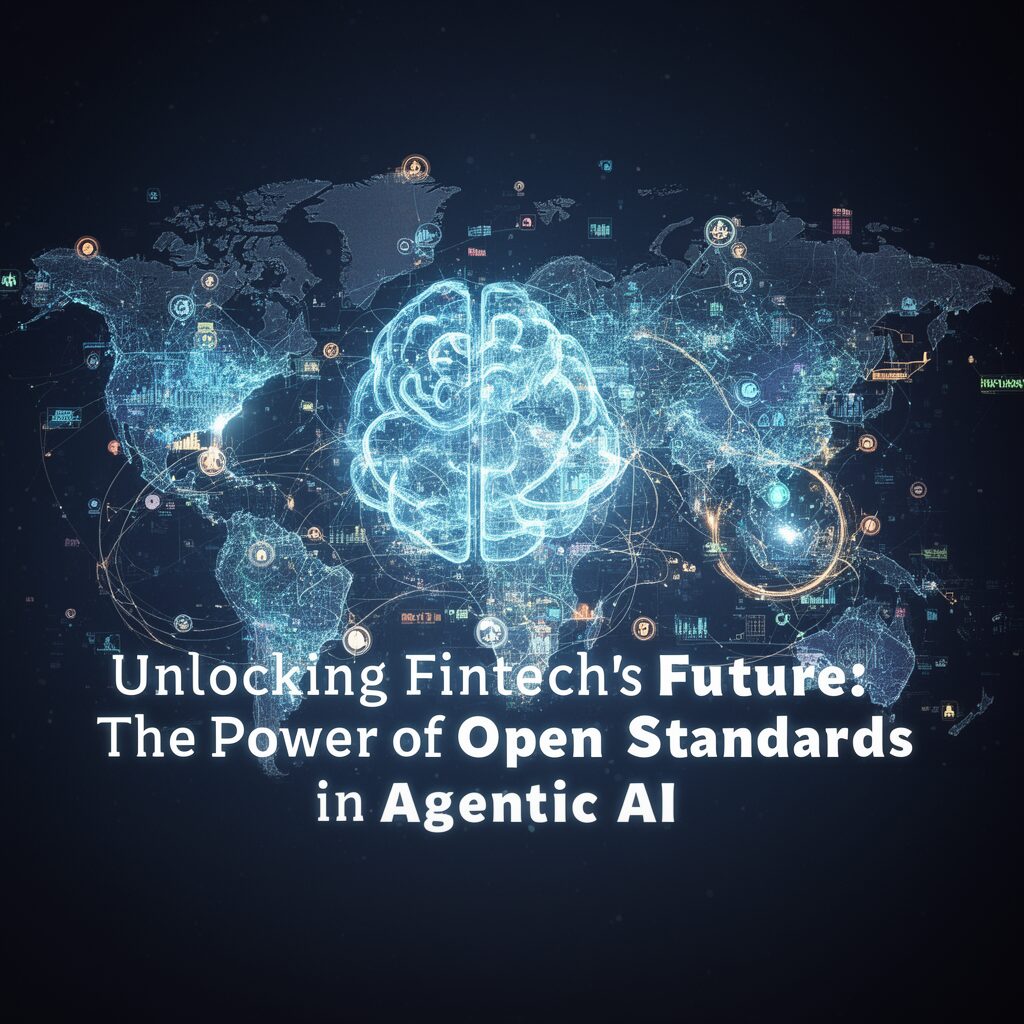
Imagine a world where financial technology works seamlessly together, without the need for expensive engineering projects or proprietary stacks. A world where agents can reason across systems, act on behalf of users, and deliver benefits that compound rather than fragment. Welcome to the future of fintech, powered by open standards and agentic AI.
## The Limits of Agentic AI in a Silo
Fintech has historically grown through proprietary stacks. That model worked in the past, but agentic AI exposes its limitations. Agents need consistent access to context, action surfaces, and signals from multiple systems. When every institution structures transactions, identities, risk indicators, and merchant profiles differently, agentic AI runs into serious obstacles. Fragmented data undermines agents’ ability to reason or take confident action. Integration friction slows deployment and increases engineering costs. Vendor lock-in forces companies to choose less effective tools simply because they fit the existing architecture, or worse still, create their own silos which just compounds the problem.
## Why Open Standards Change Everything
Open standards (shared schemas, definitions, and protocols) do far more than simplify integration. They create the foundation for scalable and interoperable agentic behavior. Before agents can reason across systems or act on behalf of users, those systems must speak the same language. The Model Context Protocol (MCP), an open standard that gives AI systems the ability to interact with real-world tools and data, is a great example of this. With interoperable protocols, agents can interpret data with greater contextual understanding. Fragmentation, by contrast, limits the quality of signals on which agents rely.
## Build the Rails, Not the Walls
The next decade of fintech will be defined by companies that understand that agentic AI is not a single product. It is a platform for reasoning, action, and collaboration across systems. Platforms only scale when the industry agrees on the rails they run on. The Agentic AI Foundation (AAIF) represents an important first step, but it’s only the beginning. To unlock the full potential of agentic AI, fintech needs to get involved. We need open data schemas specifically designed for financial primitives: merchants, transactions, identities, risk signals, and payment flows. Some commerce and payment protocols already exist and more are being proposed, but they still need industry-wide buy-in and collaboration to become true standards rather than isolated implementations.
The strongest companies will differentiate in experience, risk management, and intelligence, not in proprietary plumbing. The history of the internet shows that strong infrastructure can expand opportunity rather than reduce it. Agentic AI offers a chance to do it again. As we move forward, it’s essential to remember that open standards are not a hindrance, but a liberator. They enable companies to focus on what matters most: delivering innovative experiences and solutions to their customers.
Manik Surtani is the Head of Open Source at Block, Inc. At Block, Manik has previously led engineering teams at Square and Cash App. Before joining Block, Manik was Staff Engineer at Red Hat. He was the founder and lead engineer of the Infinispan project and platform architect on the JBoss Data Grid. Manik has a background in AI, distributed and fault-tolerant systems, and performance tuning of JVMs. Manik is a strong proponent of open source development methodologies, ethos, and collaborative processes, and has been involved in open source since his first forays into computing.