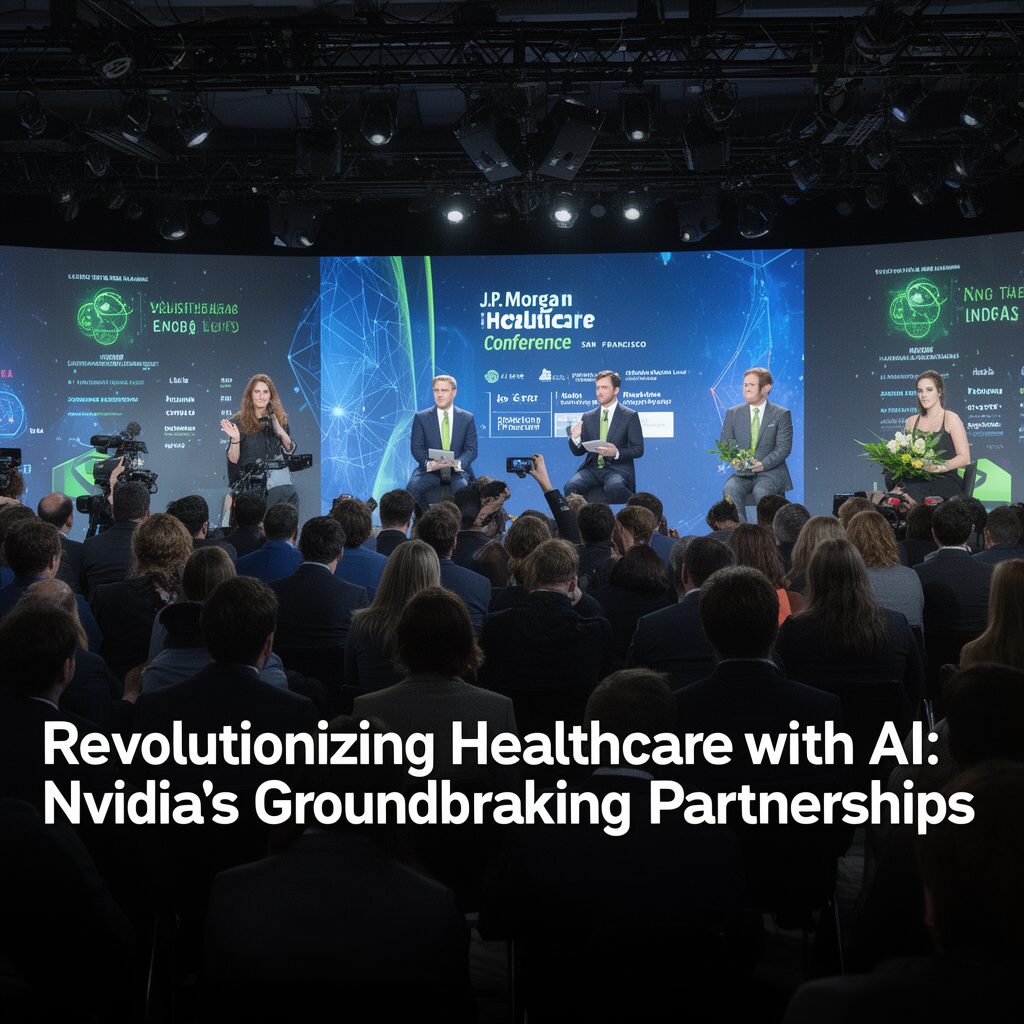
At the J.P. Morgan Healthcare Conference in San Francisco, Nvidia made a series of announcements focused on leveraging its AI capabilities by partnering with healthcare leaders to tackle key medical challenges. AI has tremendous potential to change the way we live, with some of the biggest applications in healthcare, helping people live longer and healthier lives.
The Santa Clara AI powerhouse’s announcements included partnering with pharma giant Lilly to build a $1 billion joint research lab that will use AI to accelerate development and availability of new drugs and medical treatments. Nvidia is also collaborating with Thermo Fisher Scientific on an autonomous lab infrastructure to make scientific instruments intelligent and laboratories more autonomous to drive scalable scientific discovery.
## Improving clinical development with AI models
The co-innovation lab with Lilly is a five-year commitment dedicated to accelerating closed-loop discovery and creating AI models to improve clinical development. By combining Lilly’s deep domain expertise in drug discovery with Nvidia’s expertise in AI and accelerated computing, the two companies aim to accelerate how medicines will be designed and developed.
During the event, Nvidia cited the growth of powerful open AI models as a key driver of healthcare discoveries and delivery. Open models are the backbone of modern innovation. Nvidia provided several supporting data points, including 80% of the world’s startups are built on open models.
## Alliance with Thermo Fisher to advance scientific AI infrastructure
Nvidia and Thermo Fisher Scientific are collaborating to power AI-based solutions and laboratory automation. The work will use Nvidia’s AI platforms and Thermo Fisher’s solutions to drive growth in laboratory automation, accuracy, and speed. Leveraging NVIDIA DGX Spark as a benchtop AI supercomputer, Thermo and Nvidia built and deployed quality control and analytics agents to help scientists interpret data as it’s generated, flag anomalies, validate results, and recommend adjustments before the next run.
## Expanding the BioNeMo open-development platform
Nvidia’s BioNeMo, a development platform and software ecosystem designed to accelerate AI-driven drug discovery and other biological research, is now a full open-development platform. BioNeMo enables the full lifecycle of AI development in life sciences by connecting experimental data directly to model training. This turns every experiment into digital intelligence and creates a closed loop that continuously accelerates scientific discovery.
Nvidia is also introducing new libraries for large-scale molecular AI workloads, providing 10 to sometimes 100 times, depending on the workflow, speedup of turning hours of chemistry processing into minutes, and an open-source recipe for easily accelerating and scaling biology and chemistry foundation model training.
## Multiplying training and robot deployment
Nvidia also announced a partnership with Multiply Labs, a San Francisco-based robotics company that builds automated manufacturing systems to produce advanced, individualized cell and gene therapies at an industrial scale. Using NVIDIA Omniverse and NVIDIA Isaac, Multiply creates digital twins of entire labs to train robots on thousands of sterile, precision tasks before they ever touch the real world, combining simulation, imitation learning, and Nvidia’s GR00T foundation model.
## Final thoughts
With AI, Nvidia has been a thought leader and visionary for the technology. The company understands that AI has the potential to create a “rising tide” that could lead to an economic boom larger than the one the Internet brought. Its primary message to the industry is around openness, as that allows more companies to benefit. These healthcare announcements are good examples, as they allow several partners to forge ahead and bring us closer to a future with accelerated development of more life-saving drugs and other treatments for the benefit of people everywhere.