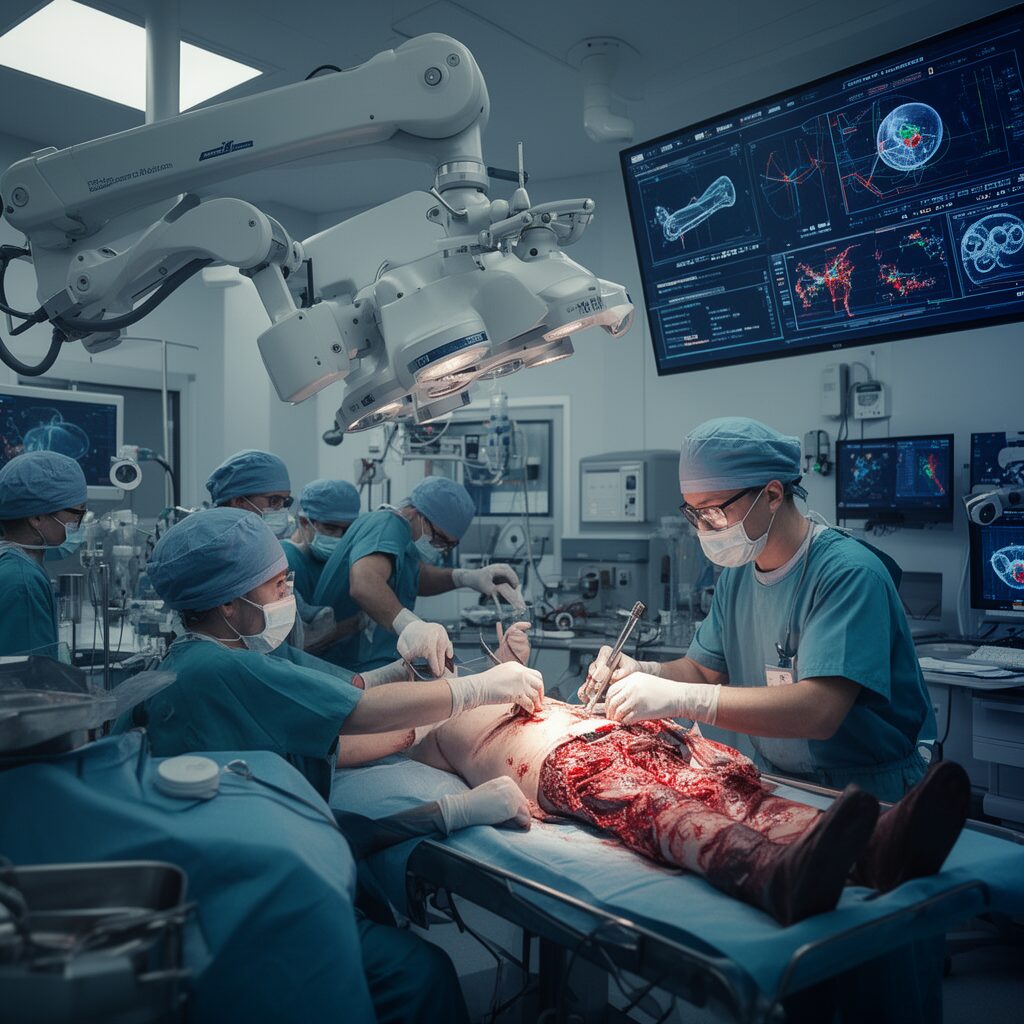
Imagine a world where medical professionals can train in a highly realistic and immersive environment, free from the limitations of traditional 2D videos and oversimplified simulations. A world where robots can assist in rescue operations with unprecedented precision, and where machine learning models can identify inefficiencies in emergency medical workflows. This world is becoming a reality thanks to the Emergency Medical Procedures 3D Dataset, or EMP3D, a groundbreaking resource developed by researchers at Tianjin University.
The EMP3D dataset captures the intricate movements of medical professionals during life-saving interventions with unprecedented precision. Using synchronized multi-camera systems, advanced AI algorithms, and rigorous human validation, EMP3D creates the first 3D digital blueprint of emergency medical workflows. This innovation holds the potential to fundamentally transform emergency medical training and enhance robotic support in healthcare settings.
## EMP3D in action: A new era for emergency care
The ultra-high precision of EMP3D can give rise to transformative downstream applications. AI Coaches for Medics can evaluate and provide feedback on the trainee’s performance in real time during operations such as chest compressions or hemostasis. Rescue Robotics can mimic the actions of rescue workers and assist in carrying out rescue operations. Crisis Analytics can identify inefficiencies in a team’s workflow during mass casualty incidents.
## The significance of EMP3D: Leverage metaverse technology to facilitate the widespread dissemination of emergency medical knowledge.
Current training tools for emergency medicine rely heavily on 2D videos or oversimplified simulations, which fail to capture the spatial complexity and split-second decisions required in real-life emergencies. This gap limits the effectiveness of AI-driven tools, robotic assistants, and virtual reality training platforms. The EMP3D dataset directly addresses these challenges by offering high precision reconstruction, AI-ready infrastructure, and open access.
The dataset’s creation involves a meticulously designed four-step pipeline. First, multi-view chaos is transformed into order using six GoPro cameras strategically positioned around an emergency room. Next, multi-view reconstruction is achieved using RTMPose algorithms, 2D poses are extracted from each camera view, and 3D skeletal motion is reconstructed. Tracking in emergency medical settings is then performed using a custom Tracking Module, which maps the trajectories of rescuers and patients frame-by-frame. Finally, raw 3D joints are refined into SMPL-H body models via two-stage optimization, and every frame undergoes manual inspection.
The EMP3D dataset has the potential to revolutionize emergency medicine training and robotic assistance. By leveraging metaverse technology and providing a 3D digital blueprint of emergency medical workflows, EMP3D can facilitate the widespread dissemination of emergency medical knowledge and improve patient outcomes. As researchers continue to develop and refine this technology, we can expect to see significant improvements in emergency medical training and robotic support in the years to come.
Source:
[Tianjin University](https://cic.tju.edu.cn/english/home.htm)
Journal reference:
Bao, H., _et al._ (2025). EMP3D: an emergency medical procedures 3D dataset with pose and shape. _Frontiers of Computer Science_. doi: 10.1007/s11704-025-41174-x. [https://link.springer.com/article/10.1007/s11704-025-41174-x](https://link.springer.com/article/10.1007/s11704-025-41174-x)