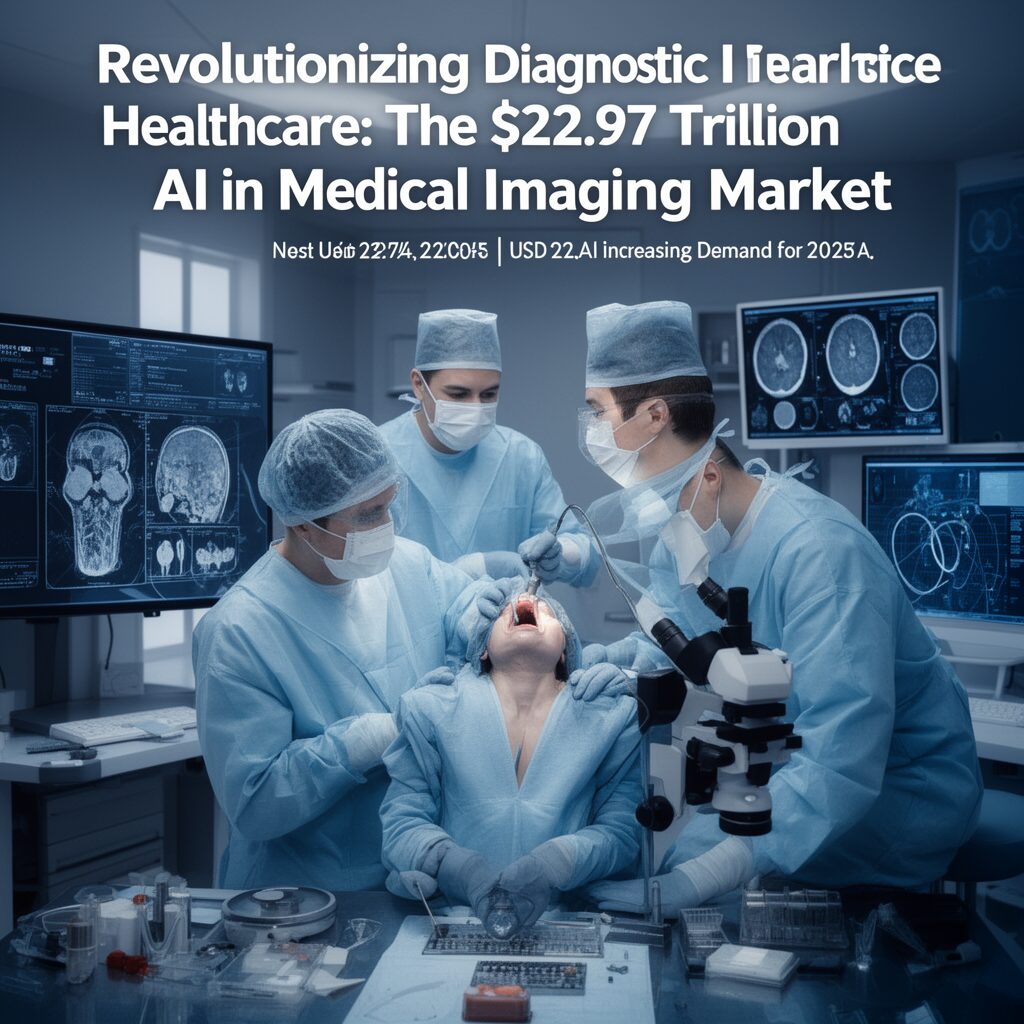
The global AI in medical imaging market is set to grow rapidly, reaching nearly USD 22.97 trillion by 2034, increasing from USD 2.01 trillion in 2025. This growth is driven by rising demand for early disease detection and automated radiology workflows. Increasing imaging volumes, growing chronic disease prevalence, and radiologist shortages are accelerating the adoption of AI across CT, MRI, X-ray, and ultrasound imaging.
## Early Detection and Personalized Medicine
AI in medical imaging is the process of using computer algorithms for the efficient & accurate diagnosis of diseases. AI minimizes scanning time and easily identifies complex patterns in magnetic resonance imaging (MRI), X-rays, & CT scans. Artificial Intelligence helps in the early detection of diseases and develops personalized treatment plans for patients. AI in medical imaging offers benefits like early disorder detection, better surgical planning, image segmentation automation, enhanced accuracy, and reduced human error.
## Key Trends and Market Drivers
Generative AI is moving into clinical practice to automate the creation of diagnostic reports and summarize patient histories for radiologists. It is also being used to create high-quality synthetic medical images, which allows for robust AI model training without compromising patient privacy or needing vast amounts of real-world data. Expansion of AI-first radiology workflows is also happening, where algorithms pre-analyze scans to flag suspicious areas and prioritize urgent cases.
Market drivers include imaging volume growth, workflow automation, cost efficiency, and reimbursement optimization. With over 5 billion imaging exams annually, growing at 6–7% per year, the demand for AI in medical imaging is increasing. The growth of chronic disorders like neurological disorders, cancer, and cardiovascular issues is also unlocking market opportunity.
## Risks and Market Restraints
While AI in medical imaging market is growing rapidly, there are risks and restraints to consider. High upfront integration costs, data bias and model generalizability concerns, and interoperability challenges with legacy systems are some of the key challenges. Data privacy and cybersecurity risks under HIPAA and GDPR are also significant concerns.
The regulatory and compliance landscape is also evolving, with over 700 AI-based medical imaging algorithms receiving clearance globally from agencies such as the U.S. FDA, European CE authorities, and China’s NMPA. With growing emphasis on Explainable AI (XAI), regulatory transparency, clinician trust, and ethical deployment are becoming more important.
## Conclusion
The AI in medical imaging market is poised for significant growth, driven by rising demand for early disease detection and automated radiology workflows. As the market continues to evolve, it is essential to address the risks and restraints, including high upfront integration costs, data bias, and interoperability challenges. With the right approach, AI in medical imaging can revolutionize diagnostic healthcare and unlock significant market opportunity.