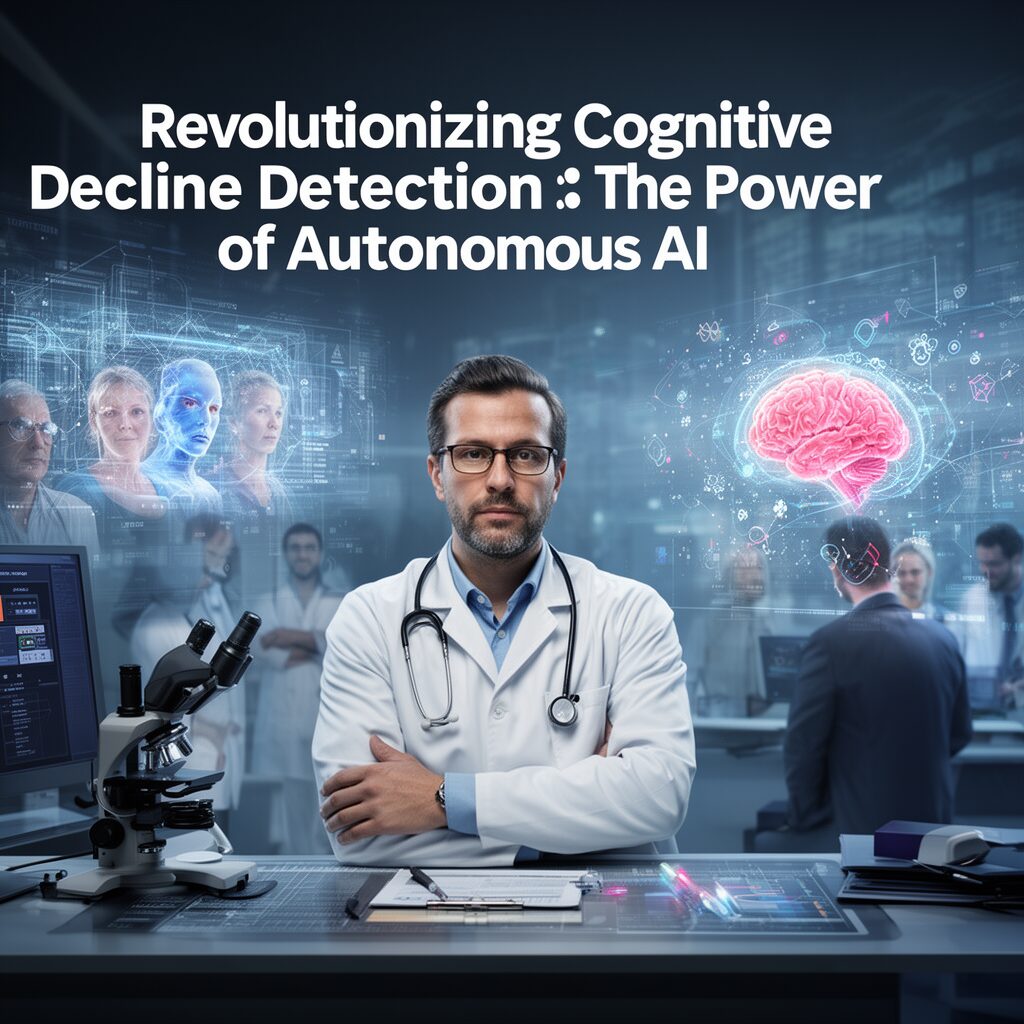
Imagine a world where doctors can pinpoint the slightest whispers of cognitive decline in their patients, long before it’s too late to make a real difference. Welcome to the revolution of clinical AI, where cutting-edge technology is changing the game for healthcare professionals and patients alike.
Cognitive decline, a hallmark of devastating diseases like Alzheimer’s, can be a ticking time bomb for older adults. But what if we told you that a team of visionary researchers at Massachusetts General Hospital has developed an autonomous AI system that can spot the early signs of cognitive impairment with uncanny accuracy? The agentic AI, which requires no human intervention after deployment, has shown a staggering 98% specificity in real-world validation testing.
## The Breakthrough: Harnessing the Power of Language Models
At the heart of this breakthrough lies the power of large language models (LLMs). By systematically processing and interpreting the complex narrative threads woven throughout medical documentation, LLMs can ‘revolutionise clinical workflows’ as Hossein Estiri, director of the Clinical Augmented Intelligence (CLAI) research group, aptly puts it. The researchers have published two large language model workflows for the AI approach in Nature’s npj Digital Medicine journal, paving the way for a new era of clinical AI.
## The Power of Pythia: An Open-Source Tool for Healthcare Systems
The researchers have also released an open-source tool, called Pythia, which they claim can enable any healthcare system or research institution to develop and deploy autonomous AI screening applications for their own purposes. ‘We didn’t build a single AI model – we built a digital clinical team,’ said Estiri, highlighting the AI system’s unique ability to include five specialised agents that critique each other and refine their reasoning, just like clinicians would in a case conference.
But why is early detection so crucial? With drugs now reaching the market that can help slow down cognitive decline, the window for effective treatment is rapidly closing. ‘By the time many patients receive a formal diagnosis, the optimal treatment window may have closed,’ warns Lidia Moura, co-lead study author and expert in the field of neurology. That’s where the AI system comes in – ‘listening at scale’ to the subtle whispers of cognitive decline in clinical notes.
## The Numbers Don’t Lie: AI’s Impressive Performance
The study analysed over 3,300 clinical notes produced during regular healthcare visits, from 200 anonymised patients, for signs of cognitive decline. The AI agents’ conclusions were reviewed by humans, and where there was disagreement, an independent expert stepped in with a re-evaluation. The system achieved 91% sensitivity – the ability to correctly find cases – under balanced testing, but that fell to 62% under real-world conditions. On the other hand, specificity – ruling out negative cases – was near-perfect.
But the real game-changer is the AI’s ability to make sound clinical judgments that human reviewers had missed. Where there was disagreement between the AI and human reviewers, the expert validated the AI’s reasoning 58% of the time, suggesting that the AI is truly complementing and improving on current tools for detecting cognitive decline.
## The Field Needs to Shift: Embracing the Calibration Challenges
As Estiri astutely points out, ‘We’re publishing exactly the areas in which AI struggles.’ The field needs to stop hiding these calibration challenges if we want clinical AI to be trusted. By sharing the successes and setbacks of this revolutionary technology, we can harness its true potential to transform the lives of millions around the world.
In conclusion, the autonomous AI system developed by researchers at Massachusetts General Hospital is a beacon of hope for the future of healthcare. By harnessing the power of language models and open-source tools like Pythia, we can revolutionise the detection of cognitive decline and change the trajectory of treatment for countless patients. It’s time to join the revolution – are you ready to catch the wave of clinical AI?