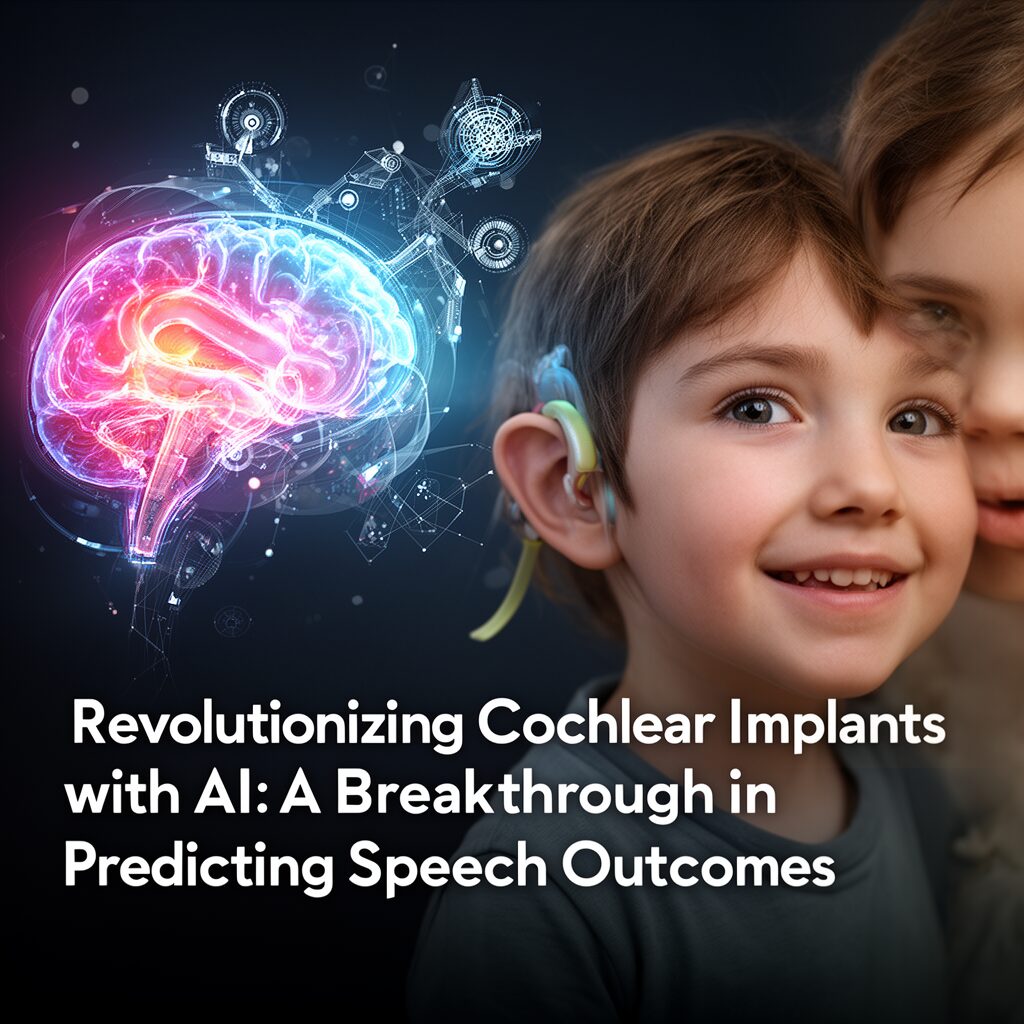
Imagine a world where cochlear implants can be tailored to each individual child, giving them the best chance at developing spoken language. A recent study has made this vision a reality, thanks to the power of artificial intelligence.
A team of researchers from the Chinese University of Hong Kong and Ann & Robert H. Lurie Children’s Hospital of Chicago has developed a deep transfer learning model that can predict how effective cochlear implants will be at improving spoken language in young deaf children. The model, which was published in JAMA Otolaryngology–Head & Neck Surgery, has an impressive accuracy rate of 92.4%.
The study followed 278 children who received cochlear implants in the US, Hong Kong, and Australia. The children were assessed before and after their implants, and their brain magnetic resonance imaging (MRI) scans were used to create a dataset for the AI model. The model was able to predict language outcomes with a sensitivity of 91.2% and specificity of 93.6%.
This breakthrough has the potential to revolutionize the way cochlear implants are used. Currently, cochlear implants are available to over 180,000 deaf adults and children in the US, but many more could benefit from them. However, the implants are most effective when implanted in younger children, as they give the developing brain access to sound and spoken language during early life.
## The Importance of Early Intervention
The developing brain is a complex and dynamic system, and early intervention is crucial for language development. Cochlear implants can provide children with the opportunity to develop spoken language, but the effectiveness of the implant depends on various factors, including the child’s age, residual hearing, and language abilities.
## AI-Powered Prediction
The deep transfer learning model developed by the researchers uses a deep neural network that has been trained on large image datasets. The model is then fine-tuned to work on a smaller, specific medical task, such as predicting language outcomes for children with cochlear implants. The model’s accuracy rate of 92.4% is impressive, and it outperforms standard machine learning methods.
The implications of this study are significant. With the ability to predict language outcomes, cochlear implant programs can tailor their interventions to each individual child, giving them the best chance at developing spoken language. This could lead to improved language development and better social and academic outcomes for children with cochlear implants.
## A Bright Future for Cochlear Implants
The use of AI in predicting language outcomes for cochlear implants marks a significant milestone in the field. It has the potential to revolutionize the way cochlear implants are used and improve the lives of children with hearing loss. As researchers continue to develop and refine AI models, we can expect to see even more exciting breakthroughs in the future.
The story of AI-powered cochlear implants is one of hope and possibility. It highlights the potential of technology to improve human lives and the importance of continued research and innovation in the field of precision medicine. As we look to the future, we can be optimistic about the potential of AI to transform the lives of children with cochlear implants.