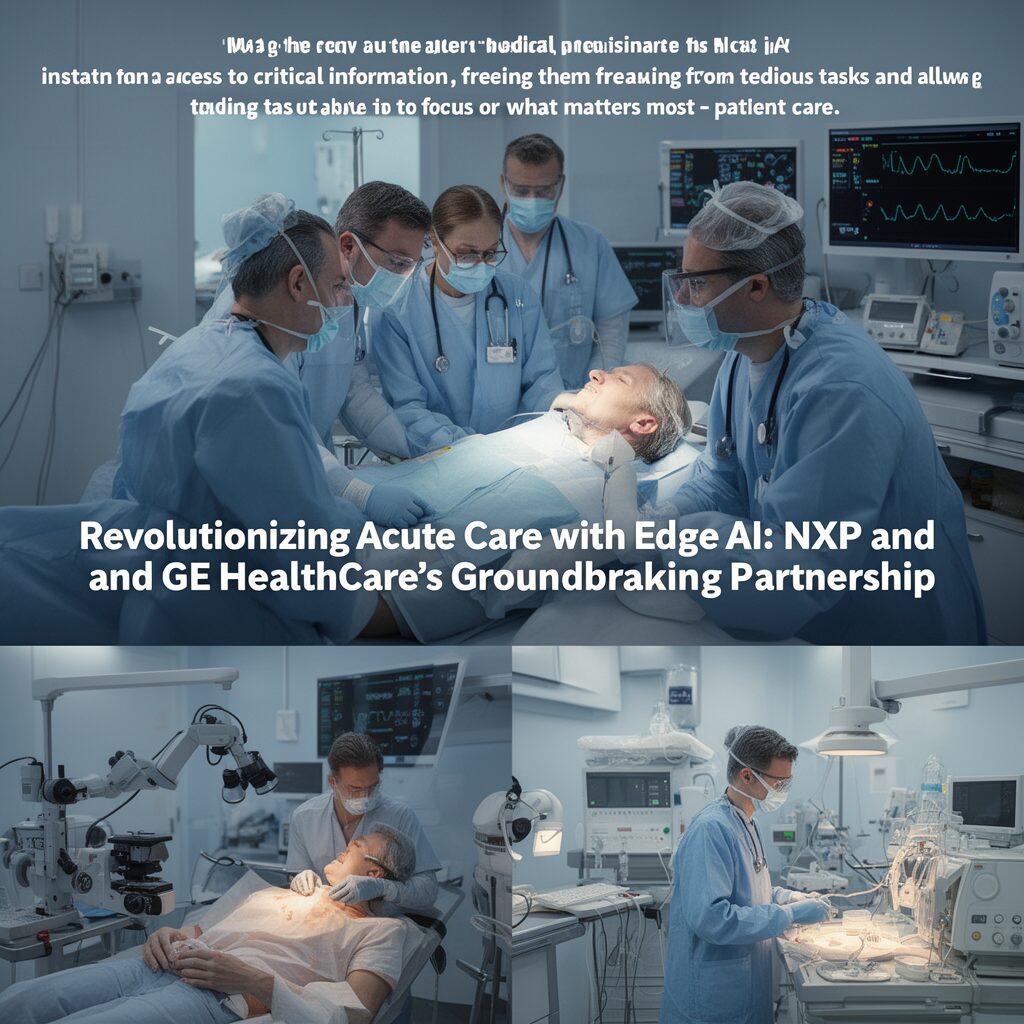
Imagine a world where medical professionals have instant access to critical information, freeing them from tedious tasks and allowing them to focus on what matters most – patient care. This is the reality that NXP Semiconductors and GE HealthCare are working towards, leveraging the power of edge AI to transform acute care environments.
## The Problem with Cloud-Based AI
Acute care settings, such as operating rooms and neonatal intensive care units, require immediate and reliable responses. However, relying on cloud-based AI can lead to latency issues, compromising the speed and accuracy of critical decisions. This is where edge AI comes in – processing data locally on the device, eliminating cloud-related delays and ensuring consistent performance even in connectivity-constrained environments.
## NXP and GE HealthCare’s Edge AI Collaboration
NXP and GE HealthCare are teaming up to bring edge AI deeper into acute care environments, unveiling new anesthesia and neonatal care concepts at CES 2026. The collaboration focuses on low-latency, on-device intelligence designed to support clinicians directly at the point of care. This partnership is a concrete example of how edge AI is moving from theory into regulated, real-world medical environments.
The first concept targets anesthesia delivery in the operating room, introducing edge AI-based voice interaction that allows anesthesiologists to control equipment hands-free using real-time voice commands. The aim is to reduce cognitive load, alarm fatigue, and the risk of human error in busy surgical environments. The second concept addresses neonatal care through intelligent, live monitoring, using on-device vision and agentic AI to detect whether an infant is crying or resting, identify foreign objects in the bed, or recognize if a baby has rolled onto their stomach.
## Responsible AI and Future Potential
Both concepts are developed under GE HealthCare’s Responsible AI principles, covering safety, security, privacy, transparency, and fairness. While the demonstrations focus on anesthesia and neonatal use cases, the companies see broader potential. “At GE HealthCare, we build AI that keeps clinicians at the center, assisting clinical judgment and freeing up time for patient care,” says a GE HealthCare spokesperson. “Collaborating with NXP helps us explore secure on-device AI as a complement to our cloud solutions,” adds another.
The partnership between NXP and GE HealthCare is a significant step towards enabling more personalized care, from continuous monitoring in the NICU and hands-free interaction with anesthesia equipment to exploratory research concepts such as AI-driven risk prediction, automated triage, and personalized treatment recommendations.
In the words of NXP, “This collaboration brings together GE HealthCare’s clinical trust and decades of medical technology innovation with NXP’s eIQ AI enablement and deep experience in secure, high-performance edge computing to provide safe, secure, and practical edge AI solutions to clinicians and patients.” The companies are demonstrating the two concepts at CES 2026 in NXP’s Pavilion, showcasing how edge AI is becoming a core technology in medical device innovation.
As we move forward, it is essential to recognize the potential of edge AI in transforming acute care environments. By leveraging local processing and on-device intelligence, we can create more efficient, effective, and compassionate care experiences for patients and clinicians alike. The partnership between NXP and GE HealthCare is a promising step in this direction, and we can expect to see significant advancements in the coming years.