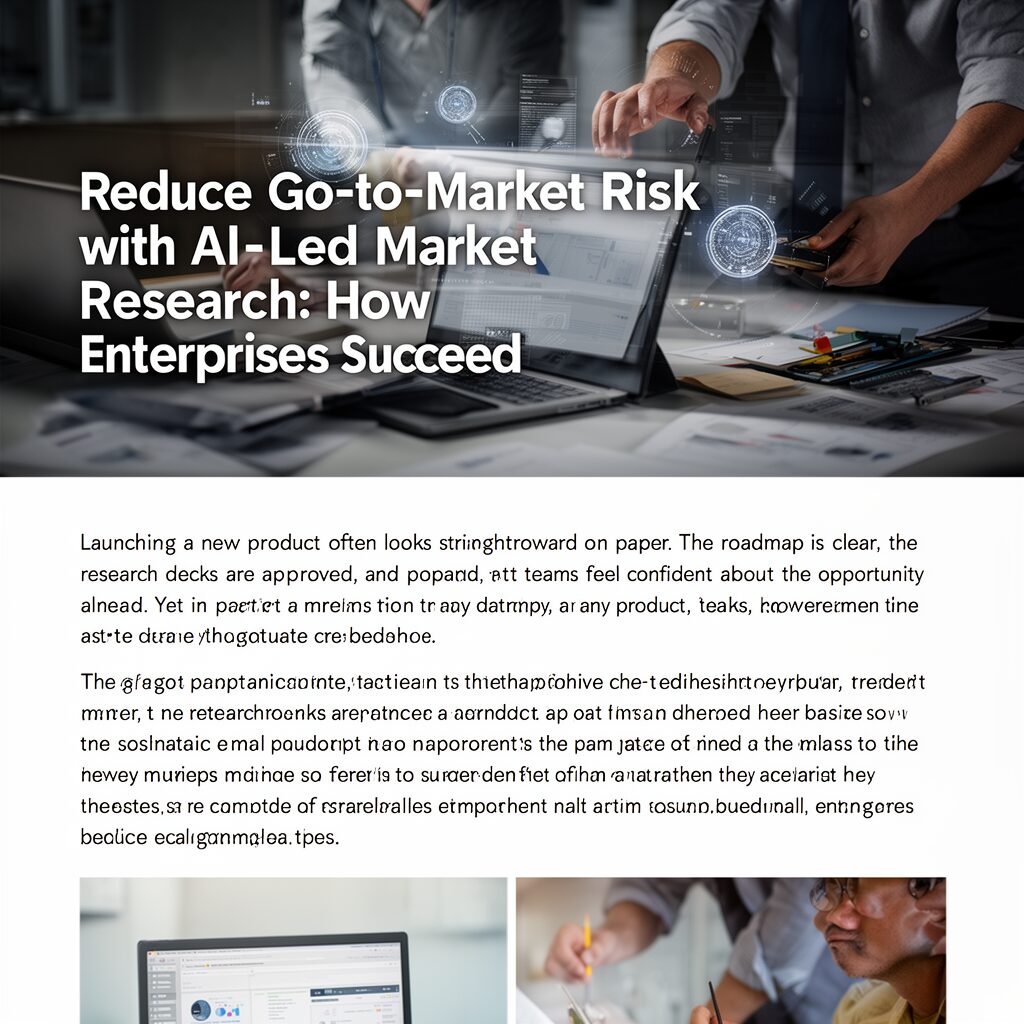
Launching a new product often looks straightforward on paper. The roadmap is clear, the research decks are approved, and teams feel confident about the opportunity ahead. Yet in practice, many launches fall short not because the product was poorly built, but because early assumptions about the market did not hold up once real buyers entered the picture. McKinsey’s recent work on growth and scaling highlights this gap clearly, especially in how AI market research is used to validate early assumptions.
## What Go to Market Risk Actually Looks Like Inside Enterprises
Go-to-market risk rarely shows up as a single, obvious failure. In most organizations, it builds quietly through a series of small decisions that seem reasonable in isolation. Each assumption feels defensible. Together, they compound into launch exposure that only becomes visible after momentum is already lost.
## Current State Of Market Research Before AI Adoption
Before AI became embedded into decision-making, most organizations followed well-established market research processes. These approaches were structured, familiar, and widely accepted, but they were built for slower markets where customer behavior and competitive dynamics changed gradually. At a practical level, traditional research relied heavily on manual execution and delayed feedback loops.
## AI Transforms Market Research
AI transforms market research from plan validation into continuous detection of demand, pricing, and positioning risks. AI insights reduce launch risk only when combined with consulting judgment that aligns teams and guides real decisions. Enterprises using AI-led market research gain stronger launch confidence by identifying risks early and avoiding costly post-launch corrections.
Most product launches fail because market assumptions break under real conditions, not because the product itself is weak. Go-to-market risk accumulates through small, rational decisions that compound when assumptions are never challenged early. Using AI for market research and consulting can help reduce launch risk. By continuously testing assumptions as markets evolve, teams can surface risk earlier, align decisions across stakeholders, and enter go-to-market planning with fewer blind spots. This approach sets the foundation for reducing launch failure before budgets, timelines, and expectations are locked in.
Most AI efforts stall at the pilot stage without structured decision frameworks, per McKinsey. To identify go-to-market risks, teams need to challenge assumptions early and often. AI consulting for product market research helps teams align decisions across stakeholders and enter go-to-market planning with fewer blind spots. By reducing launch risk, enterprises can gain stronger launch confidence and avoid costly post-launch corrections.
Common launch failure patterns include confusing interest with real buying intent, relying on limited pilot feedback as proof of scale readiness, treating historical success as a proxy for current market demand, and underestimating how pricing sensitivity shifts across segments. These gaps often survive internal reviews because no single team owns the full picture.
How internal alignment issues quietly amplify market risk product, marketing, sales, and leadership often operate with different versions of “the market.” Each team optimizes for its own goals, using different inputs and timelines. Over time, these misalignments widen the gap between strategy and execution.
AI for market research becomes most valuable when paired with cross-functional alignment. And why AI consulting for product market research plays a critical role in connecting signals across teams, not just generating insights. When combined with AI consulting, this approach helps teams surface risk earlier, align decisions across stakeholders, and enter go-to-market planning with fewer blind spots.
## Generative AI And Simulated Societies In Market Research
Generative AI is expanding market research beyond traditional human panels by enabling simulated societies built from generative agents. These systems allow teams to model buyer behavior with unprecedented scalability and realism. By testing assumptions in simulated environments, teams can uncover previously hidden risks and opportunities, making more informed decisions about go-to-market strategies.
The shift toward AI and generative AI did not replace market research, but addressed its core constraints before they translated into launch risk. AI for market research has transformed the way teams approach early validation, enabling them to continuously test assumptions as markets evolve. By reducing launch risk, enterprises can gain stronger launch confidence and avoid costly post-launch corrections.
Most AI efforts stall at the pilot stage without structured decision frameworks, per McKinsey. To identify go-to-market risks, teams need to challenge assumptions early and often. AI consulting for product market research helps teams align decisions across stakeholders and enter go-to-market planning with fewer blind spots. By reducing launch risk, enterprises can gain stronger launch confidence and avoid costly post-launch corrections.
Responsible Use Of AI In Market Research
To evaluate an AI consulting partner for GTM risk reduction, look for the following abilities: the ability to challenge assumptions, not just confirm them; experience with failed launches, not just successful ones; transparency around limitations and uncertainty; the ability to translate insights into GTM actions; experience working across cross-functional teams; governance, accountability, and decision ownership.
Industry Impact And Future Outlook For Market Research
The use of AI in market research is expected to continue growing in the coming years, as more organizations recognize the benefits of using AI to reduce launch risk and improve go-to-market success. As AI technology continues to advance, we can expect to see even more innovative applications of AI in market research, from simulated societies to predictive analytics. By embracing AI and consulting, teams can gain a competitive edge in the market and drive business growth through informed decision-making.
The first 30 days of AI-led market research typically reveal several key areas of improvement. These include a better understanding of customer needs, a more accurate assessment of market size and growth potential, and a clearer understanding of competitive dynamics. By leveraging AI and consulting, enterprises can gain a more comprehensive view of the market and make more informed decisions about go-to-market strategies.
The use of AI in market research is not a replacement for human judgment and expertise. Rather, it is a powerful tool that can help teams make more informed decisions and reduce launch risk. By combining AI with consulting and cross-functional alignment, teams can gain a competitive edge in the market and drive business growth through informed decision-making.
When done correctly, AI-led market research can lead to significant improvements in go-to-market success. By reducing launch risk and improving decision-making, teams can achieve faster time-to-market, higher customer satisfaction, and greater return on investment. The future of market research is bright, and AI is playing a key role in shaping the industry’s direction.
Appinventiv, a leading AI consulting firm, is helping enterprises reduce go-to-market risk and improve go-to-market success. By leveraging AI and consulting, Appinventiv’s clients have achieved significant improvements in go-to-market success, including faster time-to-market, higher customer satisfaction, and greater return on investment.
How Appinventiv applies AI to reduce go-to-market risk includes using generative AI to model buyer behavior, predictive analytics to identify market trends, and cross-functional alignment to ensure all stakeholders are working towards the same goal. By combining these approaches, Appinventiv’s clients can gain a more comprehensive view of the market and make more informed decisions about go-to-market strategies.
In conclusion, AI-led market research is a powerful tool that can help teams reduce launch risk and improve go-to-market success. By combining AI with consulting and cross-functional alignment, teams can gain a competitive edge in the market and drive business growth through informed decision-making. The future of market research is bright, and AI is playing a key role in shaping the industry’s direction. By embracing AI and consulting, teams can achieve faster time-to-market, higher customer satisfaction, and greater return on investment.