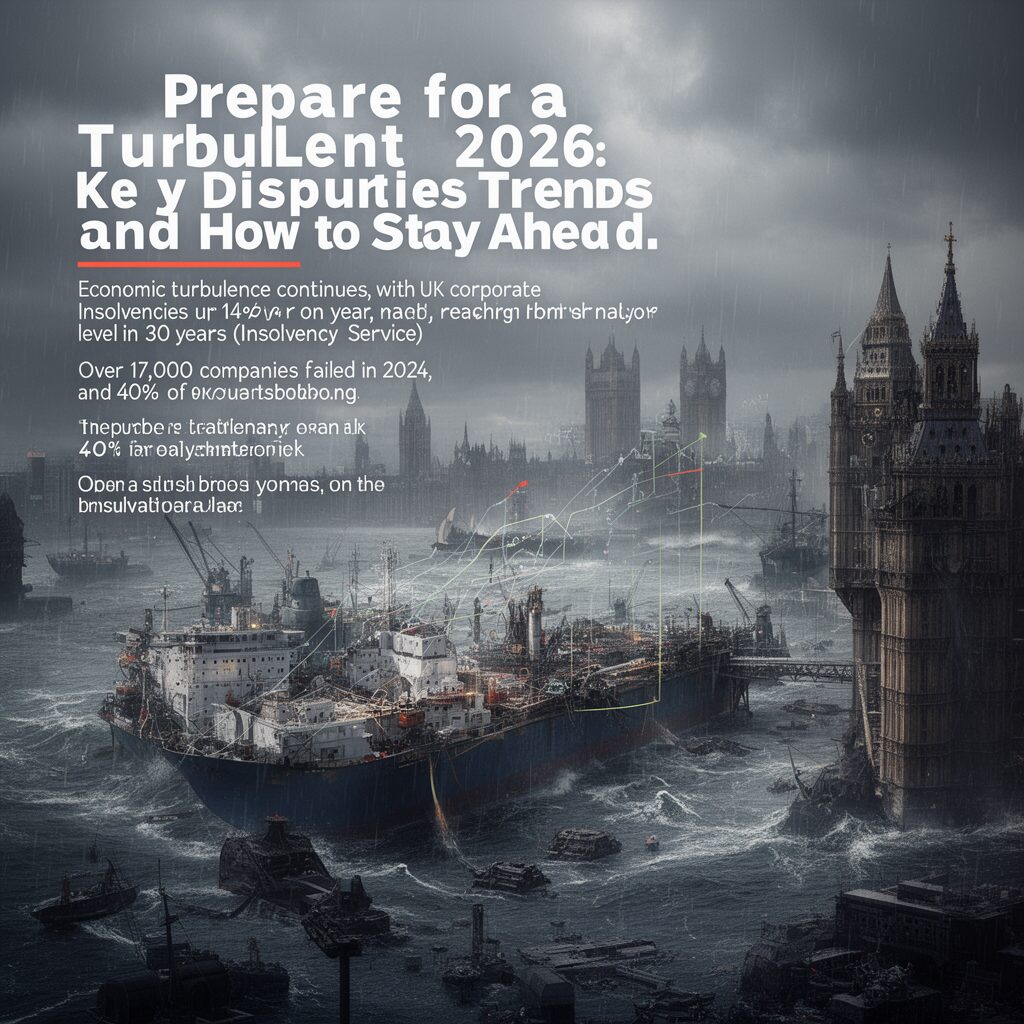
Economic turbulence continues, with UK corporate insolvencies up 14% year on year, reaching their highest level in 30 years (Insolvency Service). Over 17,000 companies failed in 2024, and 40% of UK businesses report financial distress (Begbies Traynor).
## Insolvency-driven claims on the rise
Against this backdrop, we expect a further surge in fraud, asset dissipation, and recovery claims in 2026. Insolvency practitioners are already identifying a 32% increase in suspected fraud during administrations (R3).
There is a heightened risk of being drawn into complex, multi-jurisdictional disputes as distressed businesses under pressure seek to move assets.
– Review internal controls and governance.
– Engage early with insolvency practitioners and legal advisers.
– Be prepared to seek urgent interim relief from the court to secure assets
## Increased scrutiny of directors
Claims for misfeasance and misappropriation remain high, driven by shareholder actions and post-M&A disputes. In 2024-25, 42% of UK companies reported governance or director-conduct concerns (IoD), while director and officer (D&O) premiums rose 10-15% due to increased claims (AON). Nearly one in five administrators cite director misconduct as a contributing factor in company failure.
Directors face real exposure to personal liability and reputational harm.
– Strengthen documentation of decision-making.
– Review and update D&O insurance coverage.
– Seek early legal advice where disputes begin to emerge.
## AI-enabled fraud accelerates
AI-driven and identity-based fraud is rising rapidly: AI-enabled fraud increased 52% in 2024 (KPMG), and one in three UK businesses faced deepfake or synthetic-identity attempts last year (PwC). Europol reports a 300% surge in deepfake related incidents.
AI is also reshaping litigation processes, allowing faster more efficient work to be completed.
– Invest in advanced verification and fraud-detection tools.
– Update internal policies for AI-related risks.
– Train staff to identify and escalate suspicious activity.
## Disputes become more international
Purely domestic fraud claims are increasingly rare. More than 70% of high-value commercial fraud cases in the English courts now involve foreign jurisdictions (Commercial Court Users Group). English courts handled over £3bn in disputed cross-border assets in 2024-25.
Farrer & Co remains very well placed to advise on multi-jurisdictional strategy and coordinate teams of overseas lawyers, investigators and intermediaries.
– Map international exposure early.
– Build trusted relationships with overseas advisers.
– Use English courts effectively, including for urgent interim relief.
## Crypto litigation remains active
Global crypto-related losses exceeded US$1.7bn in 2024 (Chainalysis). English courts remain a leading forum: 40% of crypto fraud victims now seek remedies through the UK, and courts issued more than 60 digital asset injunctions in 2024-25.
– Monitor crypto counterparties and exposures.
– Act quickly to preserve evidence and secure assets.
– Leverage English legal disclosure and proprietary remedies.
## Urgent interim relief continues to dominate
England remains an attractive disputes forum due to its readiness to grant urgent relief. Applications for worldwide freezing orders (WFOs) increased 22% in 2024, with around 70% granted in full or part where dissipation fears were evidenced.
– Be ready to act at short notice.
– Prepare evidence proactively.
– Consider freezing and proprietary injunctions in England as core strategic tools.
2026 will be a dynamic year for disputes. By anticipating these trends and preparing early, clients can better manage risk and seize opportunities. For bespoke advice or further insights, please get in touch with [Jolyon Connell](https://www.farrer.co.uk/people/jolyon-connell/) or your usual contact at the firm.
This publication is a general summary of the law. It should not replace legal advice tailored to your specific circumstances.