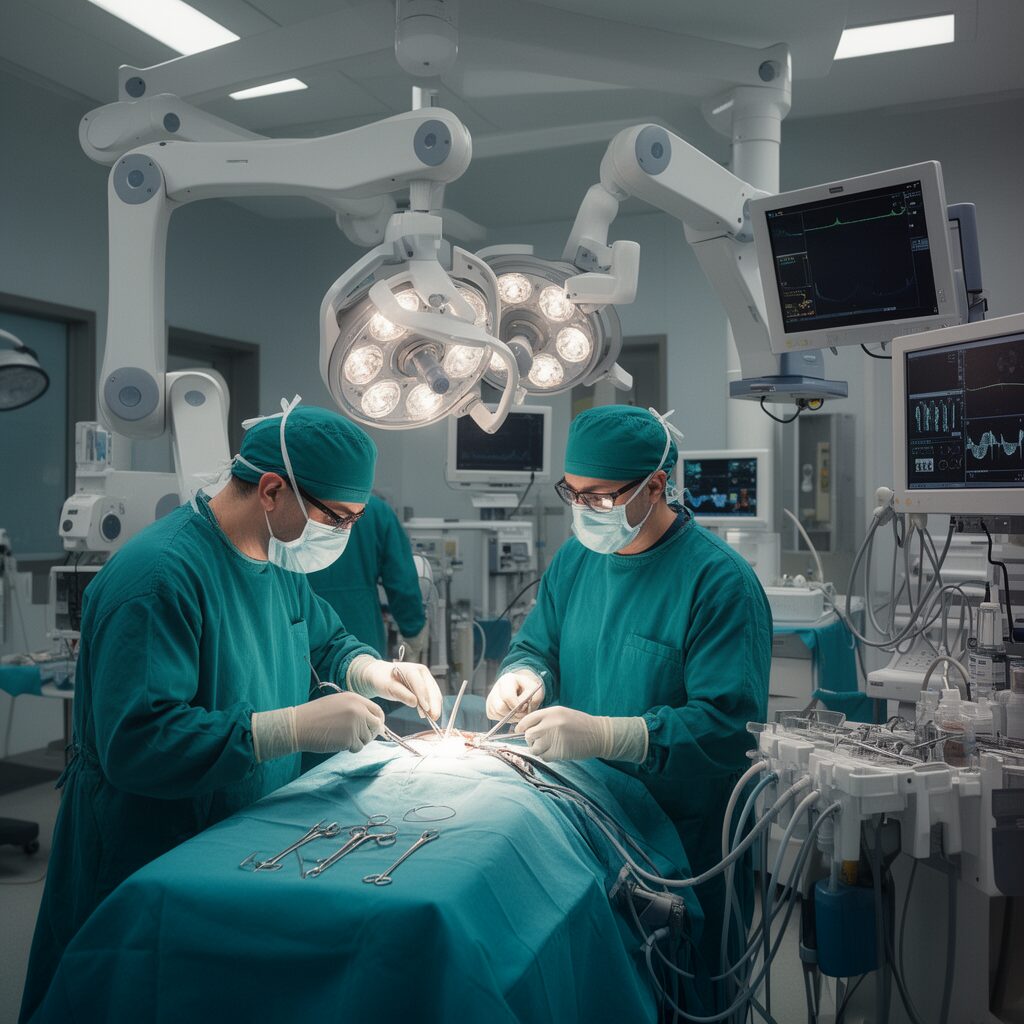
Imagine walking into an operating room where a robot, not a human, is performing surgery. It sounds like science fiction, but the rapid rise of generative AI and surgical robotics is making this a reality. Generative AI and surgical robotics are advancing so quickly that procedures once done solely by surgeons may soon be performed autonomously by robots.
## How Generative AI plus Robotics Would Perform Surgery
The idea of a robot performing autonomous surgery sounds like something out of a sci-fi movie. But the rapid development of generative AI and surgical robotics is making it possible. Generative AI systems are trained on a massive corpus of medical data, including textbooks, scientific journals, surgical videos, and clinical conversations. With billions of internal parameters, the model learns to mimic how humans solve diagnostic problems, interpret images, and execute procedural tasks.
Today’s models can already describe the precise steps required to remove a gallbladder. But executing those steps requires two additional capabilities: training on thousands of real surgical cases and a physical mechanism capable of translating surgical steps into precise movements. That’s where existing surgical robots come in. Modern surgical robots have allowed doctors to work through smaller incisions with enhanced visualization, increased precision, and tremor-free control.
## The Missing Link: Training and Mechanism
Over the past two decades, operative robots have allowed doctors to work through smaller incisions with enhanced visualization, increased precision, and tremor-free control. A typical robotic procedure involves the surgeon sitting at a console, watching a high-definition video feed of the operative field. Then, using hand controls, the physician directs the robot’s arms. The robot carries out movements inside the patient with sub-millimeter accuracy.
For generative AI to operate autonomously, developers would provide information and video from tens of thousands of recorded procedures. The large language model would analyze the data coming from the operative cameras inside the patient and match it to the precise hand movements surgeons make at the console in response. Over time, the model would learn to reproduce the same stimulus-response patterns that expert surgeons use.
## Putting the Robotic Pieces Together
The building blocks for autonomous robotic surgery already exist. Whether it becomes reality in five years or 10 will depend less on technological progress and more on how quickly and effectively hospitals, surgeons, and technology companies collaborate to train these systems. Three changes are needed now to prepare for that future:
A. Payment models must be updated. U.S. healthcare’s fee-for-service reimbursement system rewards higher volume, not superior clinical outcomes. Hospitals earn more when operations take longer.
B. Regulators will need to apply different approval standards. The FDA’s current evaluation framework for AI-enabled devices focuses on the specific data sets used to train an algorithm and the consistency of its outputs. That approach works for narrow AI tools that are trained on specific datasets. It does not work for generative AI, which is trained on vast, multimodal information sources and personalized inputs.
C. Medical culture will have to evolve. Clinicians have long resisted technologies that threaten professional autonomy, judgment, or income. Autonomous robotic surgery will be no exception. But rising economic pressure from the growing unaffordability of care, combined with the promise of safer and more consistent outcomes, will ultimately drive adoption.
Patients will hesitate at first. Technologies that take over tasks once performed exclusively by humans always generate concern. When ATMs were first introduced, many Americans worried their deposits might disappear. But as people gained experience and the systems proved reliable, trust grew, and the technology became routine. Generative-AI-enabled surgical robots will follow a similar trajectory.
The future of surgery is not just about replacing humans with machines. It’s about harnessing technology to improve patient outcomes, reduce healthcare costs, and increase efficiency. As we navigate this new landscape, we must be willing to adapt and learn from each other. The future of surgery is not just a technological possibility; it’s a medical imperative.