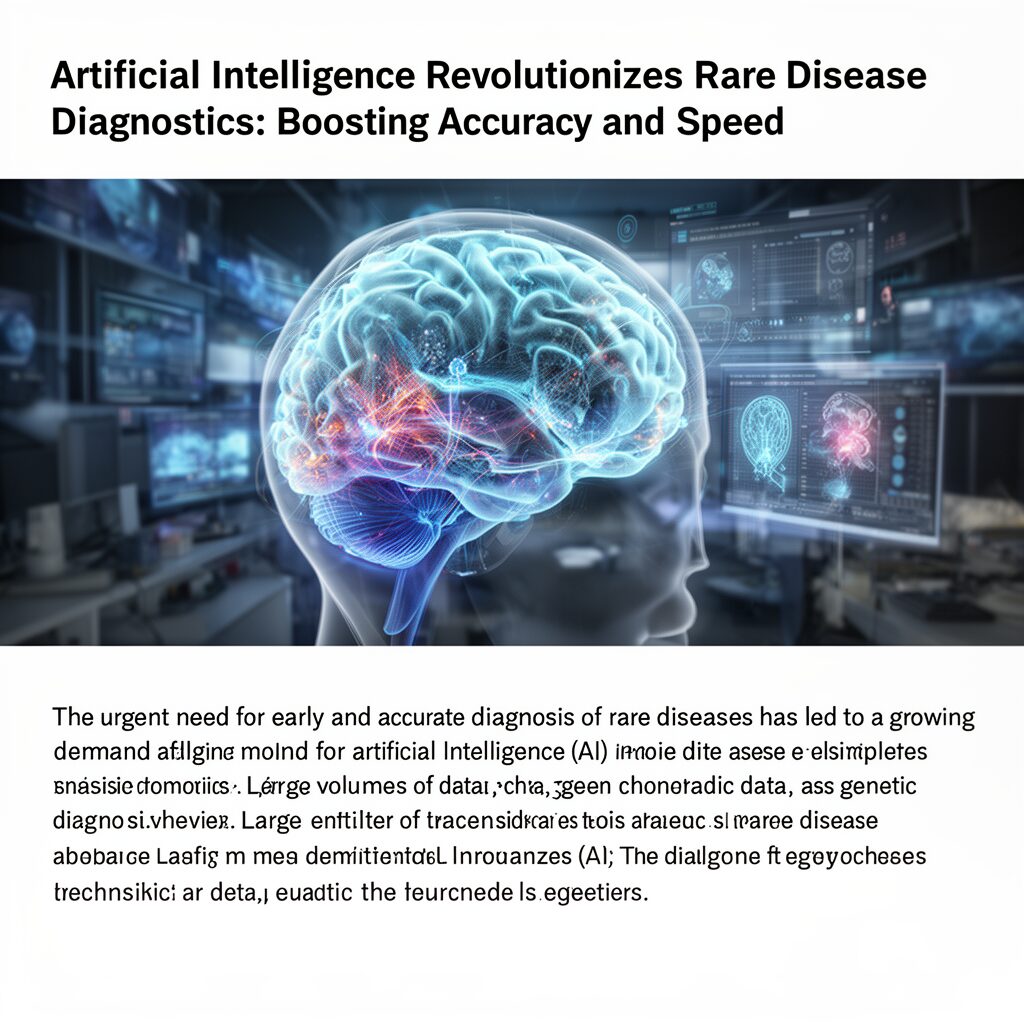
The urgent need for early and accurate diagnosis of rare diseases has led to a growing demand for artificial intelligence (AI) in rare disease diagnostics. Large volumes of data, such as genetic sequencing data, medical images, electronic health records, and clinical notes, can be processed by AI systems to identify subtle patterns and correlations that are frequently challenging for clinicians to identify. The rising incidence of chronic illnesses, the growing need for precision diagnostics, and notable developments in machine learning algorithms that improve diagnostic precision and shorten clinical decision-making times are driving the AI in rare disease diagnostics market’s expansion.
## AI-Powered Diagnostic Tools: A Game-Changer for Rare Disease Diagnosis
AI-powered diagnostic tools are transforming the field of rare disease diagnosis by enabling clinicians to quickly evaluate large and varied datasets, including genomic, phenotypic, and clinical data. This reduces diagnostic odysseys and improves patient outcomes by allowing clinicians to find illness patterns and correlations that would otherwise go undiscovered. Additionally, the ongoing development of AI algorithms guarantees that diagnostic precision increases with time, solidifying AI’s role in identifying uncommon diseases.
## Overcoming Barriers to AI Adoption in Rare Disease Diagnostics
Despite the numerous benefits of AI in rare disease diagnostics, there are significant barriers to its adoption. The scarcity of high-quality, representative data required to train and evaluate trustworthy models is a major challenge. Due to the limited patient populations associated with rare diseases, datasets are frequently dispersed between hospitals, nations, and registries, with different formats, missing clinical information, and inconsistent imaging or genomic standards. Furthermore, the sensitive nature of patient data and the difficulty of exchanging data across borders, particularly in areas with strict data security regulations, are also major concerns.
## The Future of AI in Rare Disease Diagnostics
The AI in rare disease diagnostics market is expected to grow substantially due to the expansion of newborn screening programs worldwide, an increased emphasis on precision medicine and individualized treatment, the incorporation of artificial intelligence and machine learning in diagnostics, and improved healthcare systems in emerging markets. The incorporation of AI-driven technologies in the diagnosis of rare diseases is further supported by the growing funding of rare disease research projects by governments and non-profits. Additionally, the increasing cooperation between research groups, tech firms, and healthcare institutions is encouraging innovation and knowledge exchange, which is expected to drive the market’s growth in the coming years.
The AI in rare disease diagnostics market is valued at USD 1.7 Bn in 2025 and is predicted to reach USD 19.4 Bn by the year 2035 at a 28.7% CAGR during the forecast period for 2026 to 2035. The market is driven by the growing need for early and accurate diagnosis of rare diseases, the expansion of newborn screening programs, and the incorporation of artificial intelligence and machine learning in diagnostics. The market is expected to grow substantially in the coming years due to the increasing cooperation between research groups, tech firms, and healthcare institutions, and the growing funding of rare disease research projects by governments and non-profits.