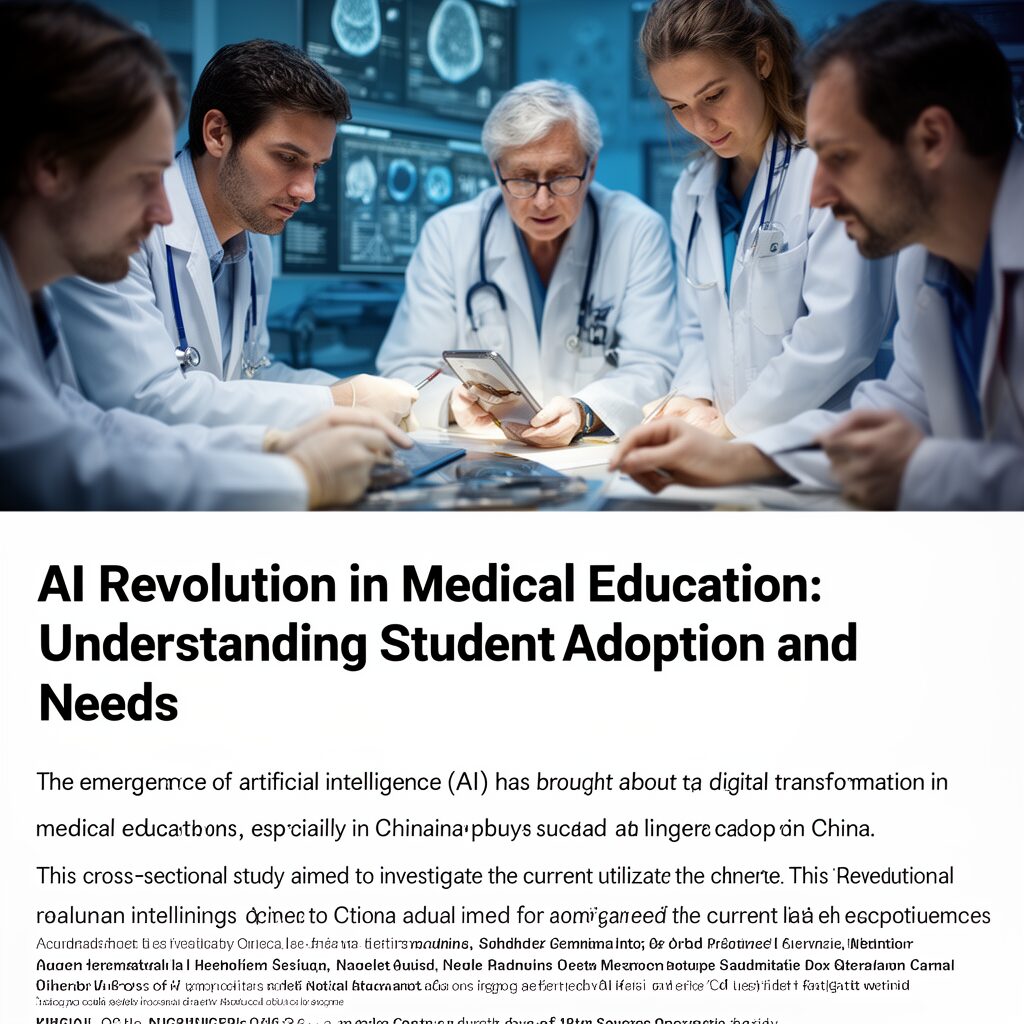
The emergence of artificial intelligence (AI) has brought about a digital transformation in medical education, especially in China. This cross-sectional study aimed to investigate the current utilization of AI tools among medical students, their frequency of use, and the purposes they serve. The researchers collected data from 428 medical students across various disciplines in Shanghai, China.
## The Rise of AI in Medical Education
The adoption of AI technology in medical education has become increasingly widespread. Over 90% of the students surveyed used more than two AI tools in their daily tasks, with an average frequency of AI-assisted learning at 5.06 times per week.
## Understanding Student Needs
The study revealed significant differences in usage patterns across disciplines, educational stages, and academic systems. The researchers emphasized the importance of understanding the actual needs of students in designing AI-powered medical education platforms.
## Practical Implications
The findings of this study have practical implications for the development of AI-powered medical education platforms. By understanding the needs and expectations of medical students, educators and developers can create more effective and user-friendly platforms that cater to the diverse needs of students.
## Conclusion
In conclusion, AI technology has become an integral part of medical education, with widespread adoption among medical students. The study highlights the need to understand student needs and expectations to inform the development of AI-powered medical education platforms.
**JMIR Hum Factors 2026;13:e81652**
[doi:10.2196/81652]
### Keywords
[AI chatbots](https://humanfactors.jmir.org/search?type=keyword&term=AI%20chatbots&precise=true); [artificial intelligence (2197)](https://humanfactors.jmir.org/search?type=keyword&term=artificial%20intelligence&precise=true); [cross-sectional study (165)](https://humanfactors.jmir.org/search?type=keyword&term=cross-sectional%20study&precise=true); [medical education (615)](https://humanfactors.jmir.org/search?type=keyword&term=medical%20education&precise=true); [medical schools (4)](https://humanfactors.jmir.org/search?type=keyword&term=medical%20schools&precise=true); [medical students (121)](https://humanfactors.jmir.org/search?type=keyword&term=medical%20students&precise=true); [technology acceptance (107)](https://humanfactors.jmir.org/search?type=keyword&term=technology%20acceptance&precise=true)
### Introduction
The rapid development of artificial intelligence (AI) has profoundly accelerated the digital transformation of medical education worldwide. AI demonstrates significant potential across multiple domains of medical education, including case-based teaching, literature analysis, and lecture support [Moro C, Štromberga Z, Raikos A, Stirling A. The effects of artificial intelligence on medical education: A systematic review.
Methods: Based on the task-technology fit model and 5 hypotheses, an anonymous online questionnaire was conducted to assess AI usage in learning, gather student feedback on AI-powered medical education platforms, and evaluate expected functionalities. The survey was conducted from March 1 to May 31, 2025, using a convenience sampling method to recruit medical students from various disciplines across Shanghai, China. The sample size was determined at 422, accounting for a 10% rate of invalid responses. The questionnaire was developed and distributed online via Wenjuanxing and promoted through WeChat groups and in-person interviews. Data analysis was conducted employing IBM SPSS Statistics (v 27.0).
Results: A total of 428 valid questionnaires were collected. The average frequency of AI-assisted learning among medical students was 5.06 (SD 2.05) times per week. Over 90% (388/428) of the students used more than 2 AI tools in their daily tasks. Students from different disciplines, educational stages, and academic systems demonstrated different usage patterns and expectations for AI-powered medical education platforms.
Conclusions: AI technology is widely accepted by medical students and is extensively applied across various aspects of medical education. Significant differences are observed in usage patterns across disciplines, educational stages, and academic systems. Understanding the actual needs of students is crucial for the construction of AI-powered medical education platforms.
### Keywords
[AI chatbots](https://humanfactors.jmir.org/search?type=keyword&term=AI%20chatbots&precise=true); [artificial intelligence (2197)](https://humanfactors.jmir.org/search?type=keyword&term=artificial%20intelligence&precise=true); [cross-sectional study (165)](https://humanfactors.jmir.org/search?type=keyword&term=cross-sectional%20study&precise=true); [medical education (615)](https://humanfactors.jmir.org/search?type=keyword&term=medical%20education&precise=true); [medical schools (4)](https://humanfactors.jmir.org/search?type=keyword&term=medical%20schools&precise=true); [medical students (121)](https://humanfactors.jmir.org/search?type=keyword&term=medical%20students&precise=true); [technology acceptance (107)](https://humanfactors.jmir.org/search?type=keyword&term=technology%20acceptance&precise=true)